Showing posts with label financial crisis. Show all posts

Thursday, November 18, 2010

The New, New Frugality.

Once again, an opinion in an earlier blog entry was reinforced through research from Booz, Allen and Company. In this report, Booz suggests that the age of frugality in America is a permanent state, much like I suggested here. The reason I bring this up is because, frankly, I like to be right. I also bring it up because I am in the middle of a project for a client who has historically marketed their products on the promise of more for less.

Besides the suggestions I laid out in the earlier post on frugality among consumers, the latest Booz report reminds me that as more marketers get on the bandwagon of frugality, marketing messages and product development, even merchandising and certainly pricing strategy will again equivocate as all marketers take such positioning and make it so much table stakes. So for my client and others like them who applied a value message as a key brand value, it becomes less and less of an effective differentiator.

Note that the New Frugality doesn't mean that everyone is looking for the lowest price, or even the best value. What it does mean is that consumers - including businesses - are looking for reasons to defend the purchases they do make, whether to colleagues, bosses... or themselves.

As marketers, that's the job New Frugality requires of us. Defending our brand and its market positioning. Just like the good ol' days. Again.
Enhanced by Zemanta

Tuesday, December 29, 2009

In which he foretold the future.

U.S. Patent . Design patent for toys (D21/813)...

So, about a year ago, I posted an entry in response to a survey from Chief Executive Magazine regarding my prognostications for the year just past. I offered my learned opinion, shared it with you, and now, in the interest of full disclosure (not to mention I'm too busy and not clever enough to come up with an original end-of-year post) here's the results:

I said:

On December 31, 2009:
Dow Jones (currently at 8,932) will be at 9621 points

Oil (currently at $40.50) will be $59 per barrel
Interest Rates (the Fed Funds Rate, currently at 1.00%) will be: 1.00%

Actually, on December 28, 2009:
Dow Jones (currently at 8,932) is at 10,547 points
Oil (currently at $40.50) is at $78 per barrel
Interest Rates (the Fed Funds Rate, currently at 1.00%) is at: .50%

Prediction comments:
(I said) Uncertainty is driving the market and the economy; once some certainty arrives with new administration - for good or bad - wild swings will stabilize and the widely oversold market and general malaise will slowly lift.
What happened:
Uncertainty was driving the market and the economy; but any sliver of not-bad, or less-bad news, swung the pendulum back just as wildly as the markets moved to cover shorts and other dubious financial mechanisms. The seating of a new administration, alas, had nothing to do with it as the market didn't settle for months after the inauguration.

Confidence comments:
(I said) Business decision-makers will become comfortable de-coupling their decisions in the real world from abstractions like the Dow. But once that fog clears, the impact of government intervention on national debt and as a general signal of the new regulatory environment will be a drag on growth.

What happened:
Ooo. Seems I was on the money; particularly regarding new regulations - and predicted tax law changes. Yet something went unsaid - the new normal of a higher savings rate, less consumer spending on credit, and general 'new religion' took hold on main street.


So there you go, there's a lot more to the year past than a brief blog post, and others would question some of my inferences, but in the end I was more pessimistic than necessary - or perhaps just more realistic - about the real state of the 'main street' economy. But the reality is far more immediate than Wall Street prognostications... to paraphrase Ronald Reagan, "Are you better off today than you were a year ago?"

Happy New Decade.


Reblog this post [with Zemanta]

Sunday, November 08, 2009

On worry and inaction

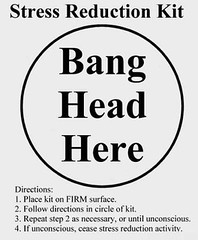
Stress Reduction Kit

Jeremy Kloubec, a former colleague of mine now with consulting organization Infosys, writes recently about the dire unrealized predictions facing the VC community just a year ago. He details the shifts in the industry and partially credits the architects of the still-nascent recovery programs.

His comments reminded me of something my mother often said: "95% of things you worry about never come to pass."

Of course, its that 5% that keep us up at night.

As it pertains to our business life, if, as Peter Drucker is credited with stating, "the best way to predict the future is to create it", then 100% of our angst can be squeezed to 5% insignificance by the simple act of
doing. Dire warnings and worry generally come with the same highly unlikely assumption: "If things do not change, ..." That peculiar assumption ignores the fact that humans - particularly capitalist humans - are not given to inaction. Even our base 'fight or flight' instinct indicates an action of one type or another. Change is inevitable.

And so it is with this crisis. We're not out of it, not by a long shot, and our myriad collective and individual actions will differ in effectiveness and certainly create new crises even as they create new solutions. But our reactions to events and the actions we take are all we've got and will continue to alter the linear path.

If history is any guide, that's more than enough.


Reblog this post [with Zemanta]

Thursday, September 17, 2009

Do The Math

Numbers in transport

A common though underutilized truism in marketing is to quantify your claims whenever and wherever possible.

'Biggest', 'Better', Fastest', 'Smallest', 'Cheapest' are nice claims but of little* value. Only slightly better are percentages, useful in any circumstance when the real numbers are small to begin with ($0.04 is a penny less than $0.05, but it is also fully 20% less)

I was reminded of this point by a number** of excellent recent blog entries that are worth a read:


How to Make Your Data Matter, Fast Company, by Dan and Chip Heath - Notable insight: "...an $800 billion stimulus works out to be the rough equivalent of seven weeks' income for an American household. Is that worth it? Seven weeks' worth of work to stave off a potential depression. Or maybe you're appalled. Regardless, we can finally have a real argument, because we have a better idea of what we're arguing about."

How Comedians Clarify Brain-fuzzing Stats, again, Fast Company, by Dan Macsai - Notable Insight: "...If Rod Blagojevich winds up in jail, four of the last eight Illinois governors will have served time. Did you know -- and this is true -- that only 48% of the people who commit murder end up in jail? You are more likely to end up in jail if you become the governor of Illinois than if you become a murderer. Make the smart choice, kids. (Jon Stewart)"

What Does A Trillion Dollars Look Like?, courtesy of cnbc.com - Notable insight: "With the largest market cap among U.S. companies, Exxon Mobil’s value of publicly traded shares is over $345 billion (as of 3/31/09). If this amount was denominated in $100 bills, the block of Benjamins covering the area of a standard American football field would stack to a height of about 28.7 feet.
"

Ultimately if your numbers are impressive or modest, whole numbers or percentages, what matters is that your audience understands them and relates to them in clear terms that mean something to them.

(*specifically, 86% less value, that is.)
(** exactly three)

Reblog this post [with Zemanta]

Saturday, February 28, 2009

Warning signs

The other night I had an "I Love Lucy" moment – I found myself desperately, and ultimately unsuccessfully, attempting to stem the tide of about 75 PSI of water shooting from what had been the stem control of an upstairs bath.

Vivian Vance (right) as Ethel Mertz on I Love ...


I had been ignoring a persistent drip for weeks.

Together with a client, I was speaking yesterday with a lovely woman who runs the Diabetes Education Center at a local hospital. The topic soon turned to preventative medicine, and the number of people who discover they have diabetes only after entering the ER with blood sugar levels in the 700s (that’s really high).

They were ignoring the frequent urination, constant thirst, weight loss, fatigue and other warning signs of diabetes.

Last month a neighbor had to be rescued from the side of a busy highway during rush hour when her transmission gave out and she slowly glided to a permanent stop on the gravel shoulder. The car had been recently detailed, however, so it looked sharp as it was hoisted onto the back of the battered tow truck.

She had been ignoring the thump and jolt from the backend of her foreign sedan for months.

And of course, we can all point fingers at the politicians and bankers and brokers and others who ignored the warning signs that have led to the current world financial credit crisis.

What are you ignoring? What are the warning signs in your own business that need attending to?

Are consumer complaints increasing? Is innovation fading? Are too many of your receivables over 120 days out? Do your employees fear the next 'all-employee meeting'? Has cash flow become the dominant topic over the water cooler, instead of tactics and strategy?

None of these scenarios are uncommon in a weakened economy. But what are you doing about it?

There are no easy answers to these problems. But analyzing the problem for weeks isn't helping. The quicker you act and the more decisive the action – any forward action – the greater the likelihood of preventing the situation from truly getting out of, that is, beyond your, control. Once a problem is beyond your control, it is too late and the options for a remedy, such as they are, are never good ones.

Okay, so this post doesn't say much that hasn't been said before. But if you've ignored the same reminders before, here's your chance to act.

Regardless of the specific corrective action required for your company's circumstance, the immediate requirement is communication. Internal and external communication to explain the company's circumstances to employees, partners and customers; reinforcement of company values and vision, and each individual's role in fulfilling the company's mission; the long term and near term future for the organization. And communication is a two –way street as well, that is, remaining open for customers to become real-time sources for feedback and product ideas, perhaps seeking out suppliers willing to extend finance terms, and listening to employees for suggestions regarding improving operational efficiencies.

The important thing is not to ignore the constant drip, drip, drip of market erosion and declining revenues, blindly hoping that a sudden macroeconomic recovery is around the corner, a rising tide that raises all boats. Don't ignore the warning signs. Take action now, because like my plumbing, the 'pressure' to take corrective action now is only building.

Reblog this post [with Zemanta]